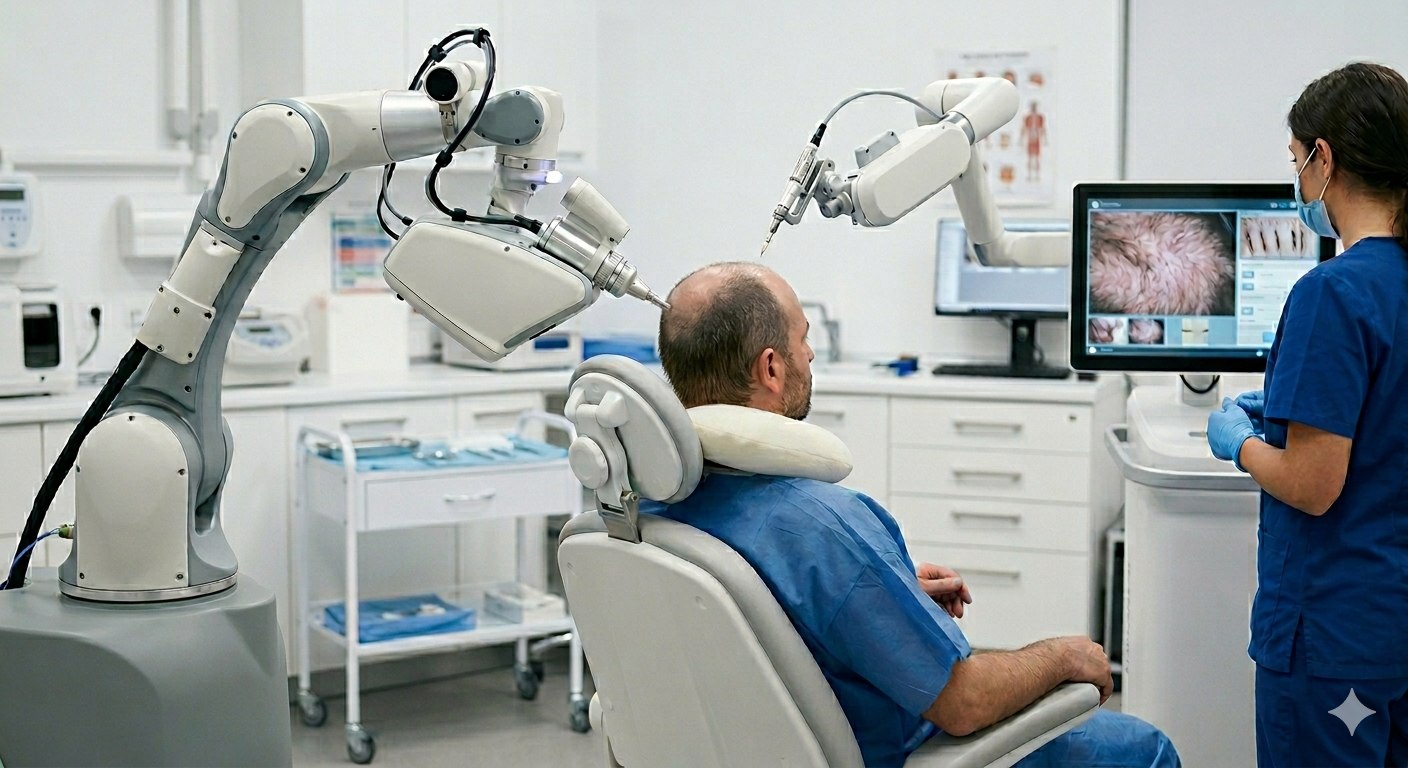
A dual-arm robotic system that scans, plans, extracts and implants hair follicles with minimal human supervision — engineered in partnership with Quimesis, a specialized robotics engineering firm.
Outside of shaving, anesthesia and disinfection (handled by the clinical team), the entire cycle is designed to run autonomously under a doctor's supervision.
The robot scans the scalp, mapping the location and orientation of every hair follicle and defining donor and recipient areas.
The system identifies the number of grafts to transplant and sequences the procedure. The doctor and patient review and approve the plan on screen.
The first robotic arm locally identifies, cores and extracts each follicle, then transfers it to the implantation arm.
The second arm injects each follicle with correct orientation and verifies implantation quality — graft by graft.
Extraction force, coring depth and other procedural variables are continuously optimized by integrated machine learning algorithms — so outcomes keep improving over time, without depending on any single operator's skill or fatigue level.
The result is a system that targets >95% graft yield at roughly 3–4 hours per procedure (about 4,000 grafts) — twice as fast as a manual procedure, with far less variability.
We've already de-risked the most technically demanding part of the project: a robotic arm that autonomously identifies and extracts hair follicles after precise micro-localization.
Robotic arm capable of autonomously performing hair coring and extraction after micro-localization.
Scalp scanning, automated extraction and sorting, and implantation via a second robotic arm — plus pre-clinical evaluation of the complete system.
Clinical trials and robot reliability testing, with verifications and validations in preparation for certification.
CE Mark certification and preparation for commercialization. As an intrusive but non-critical device, the Samson Robot is expected to fall under Class 2a — a comparatively achievable regulatory path.
Go-to-market: selling robots to practitioners and deploying Samson-operated treatment centers.
Our closest competitor is the only other robotic system on the market — but it automates only part of the procedure.
| Closest Competitor | Samson Robot | |
|---|---|---|
| Automation level | Semi-automatic coring & implantation; manual sorting between steps | End-to-end autonomous cycle |
| Staff required | 3–4 medical professionals throughout | Minimal supervision (doctor/nurse) |
| Typical throughput | ~2,000 grafts in 8 hours | ~4,000 grafts in 3–4 hours |
| Core design era | Original platform released nearly two decades ago | Built on modern robotics & machine learning |
| Economics | High acquisition cost + labor still required | Labor cost sharply reduced |
Source: Samson Robotics investor materials.